Horological Engineering & Architecture

Mechanical Movements & Horological Craftsmanship

An authoritative exploration of mechanical calibers, energy storage, oscillating regulation, and the microscopic artistry that defines fine Canadian workshop horology.

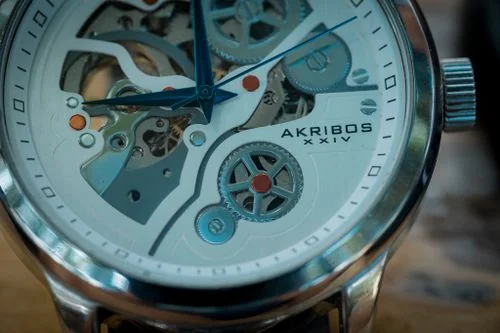
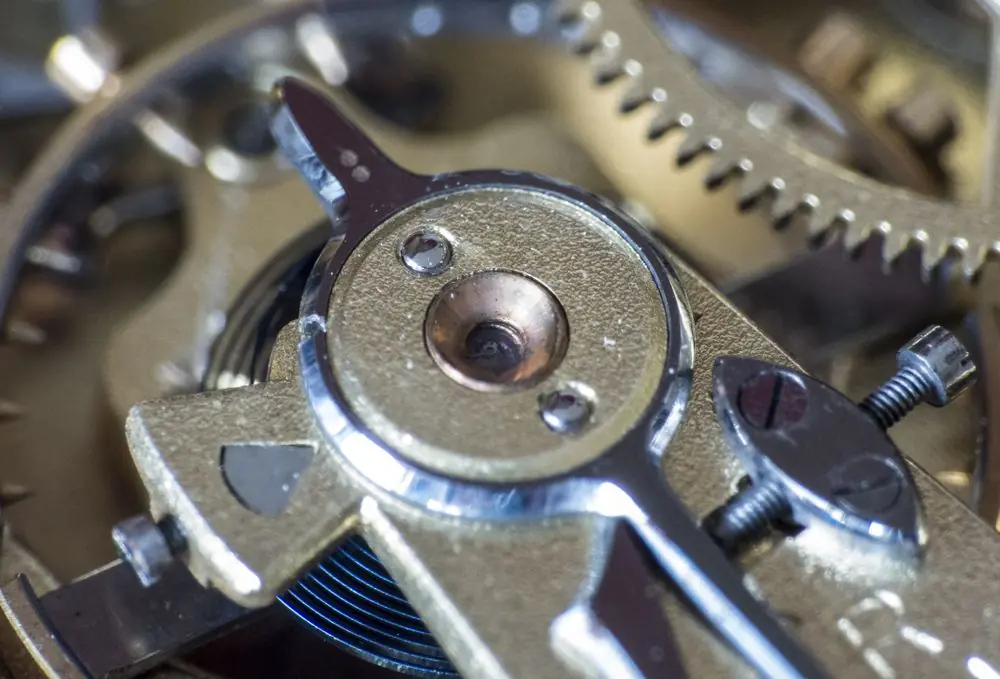
Close-up macro view of mechanical watch movement displaying synchronized brass wheels and steel bridges
Caliber Study No. 01
Primary gear train engaging the fourth wheel and escapement bridge
Kinetic Anatomy

Core Components and How They Work

Every mechanical movement converts coiled mechanical potential into measured, acoustic pulses. Below is an examination of the interdependent sub-assemblies governing kinetic timekeeping.

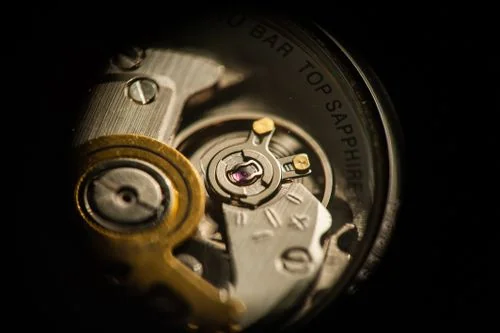
Exposed balance wheel and hairspring showing synthetic ruby pivot bearing
Regulation System

Balance Wheel & Hairspring

Oscillating at precise frequencies, the balance wheel is the heartbeat of a mechanical watch. Paired with a delicate coiled hairspring, its mass and elasticity dictate exact temporal division, swinging back and forth with symmetrical poise.
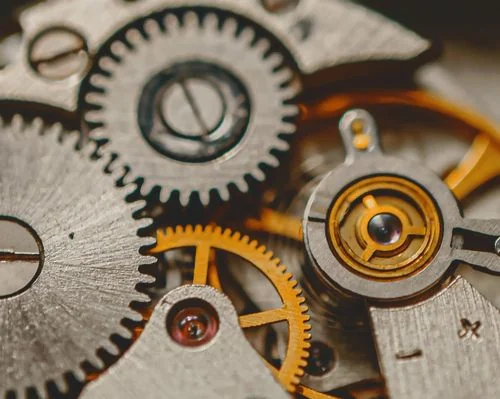
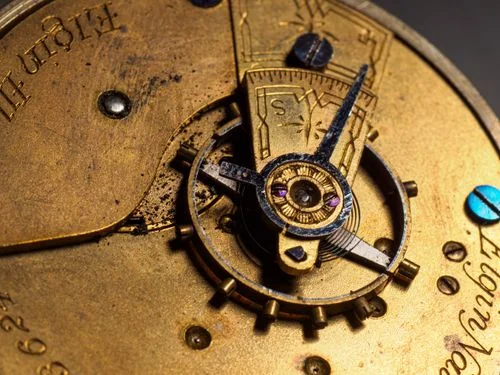
Precision metal escapement wheel and mechanical gear train assembly
Impulse & Release

Escapement Mechanisms

The escapement converts rotational energy from the gear train into discreet rhythmic impulses. The pallet fork arrests and releases the escape wheel tooth by tooth, delivering energy to maintain the balance wheel’s continuous oscillation.

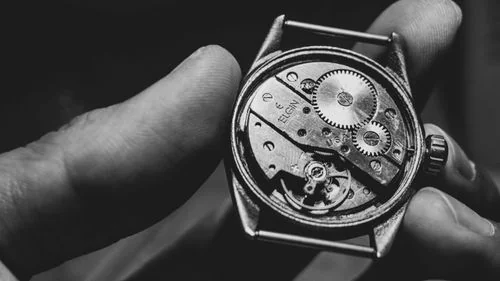
Antique brass gear train wheels and pinions fitted between movement plates
Kinetic Transmission

The Gear Train

A stepped series of toothed wheels and leaves called pinions: the center wheel, third wheel, and fourth wheel step up rotational speed while stepping down torque, transferring force smoothly from the mainspring barrel to the escapement.

Mainspring barrel assembly and hand-winding ratchet mechanisms
Energy Storage

Mainspring & Barrel Assembly

Housed inside a toothed barrel drum, a long S-shaped spring made of specialized high-tensile alloy stores tension. As it slowly uncoils, it delivers stable, measured driving torque through the teeth of the barrel perimeter.

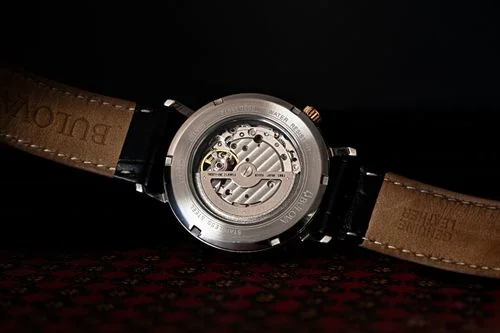
Oscillating weighted winding rotor on an automatic wristwatch caliber
Winding Architecture

Manual vs. Automatic Winding

Manual calibers require deliberate tactile winding via the crown and stem. Automatic calibers introduce a weighted oscillating rotor that swings freely with natural wrist movement, tensioning the mainspring through a reduction gear system.

Watch movement base plate, bridges, and jeweled chatons viewed in profile
Structural Foundation

Bridges, Plates & Synthetic Jewels

The mainplate provides rigid seating, while bridges secure spinning arbors with micron-level alignment. Synthetic sapphire jewels serve as low-friction bearing surfaces, holding micro-droplets of specialized lubricant for decades of reliable rotation.

Surface Architecture

Finishing, Decoration and Movement Design

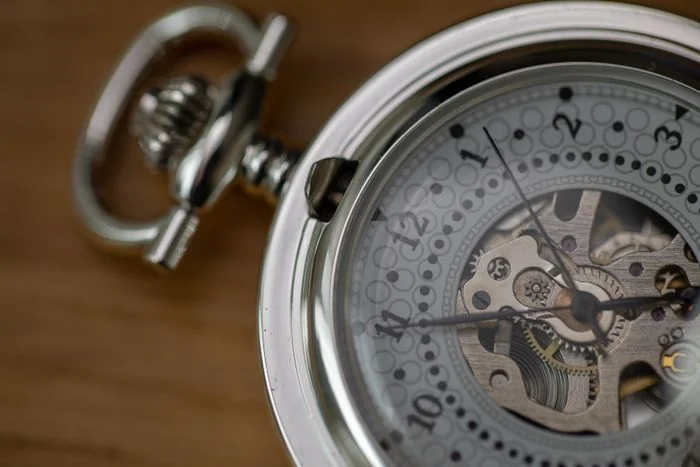
Detailed close-up of beveled edges and decorated steel bridges on an open mechanical movement

Finishing in fine horology is not mere adornment; it is the final disciplinary stage of metal preparation. Smooth chamfers eliminate microscopic burrs that could dislodge under shock, while polished surfaces resist corrosion and distribute internal ambient light across the mechanical landscape.

Anglage & Hand Beveling

The meticulous practice of paring away the crisp 90-degree outer edge of a steel or brass bridge using graduated files, degussit stones, and wooden pegwood lap sticks. A masterfully executed chamfer creates an even, gleaming 45-degree mirror reflection along the entire contour of the component.

Côtes de Genève & Linear Graining

Parallel wave patterns applied to top plates and bridges. Using abrasive boxwood laps or diamond paste, regular wave crests are impressed into the metal surface, creating light-catching ribbons that unify separate bridge elements visually across the caliber.

Perlage (Circular Graining)

Interlocking circular cloud motifs applied to the mainplate, recessed recesses, and underneath balance cocks. Each concentric circle is positioned by eye with uniform overlap, ensuring structural plates retain an immaculate texture that diffuses internal reflection.

Traditional vs. Modern Caliber Architecture

Traditional architecture emphasizes three-quarter plates, screwed gold chatons, and classical finger bridges rooted in Swiss and Saxon heritage. Contemporary design introduces openworked bridges, DLC coatings, and geometric skeletonization that celebrate structural kinematics from every viewing angle.

Technical Spotlight

Escapement & Regulation Dynamics

The balance wheel and escapement form the autonomous regulating organ of a watch. Their synchronized interplay determines whether a timepiece gains or loses seconds across varied orientations and temperatures.

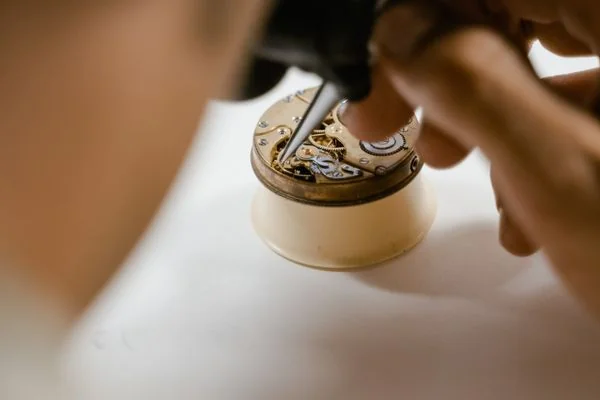
Horological technician inspecting delicate balance assembly with specialized bench tweezers
Static Alignment Under Magnification
Ensuring the hairspring breaths concentrically without touching curb pins or center wheels during full amplitude swings.
Sub-Assembly 01

The Swiss Lever Escapement

Comprising the escape wheel, pallet arbor, and synthetic ruby pallet stones (entry and exit). Each swing of the balance pin delivers an impulse through the fork horns, releasing the escape wheel exactly one tooth at a time while imparting a micro-kick of energy back to the roller jewel.

Key Focus: Lift angle geometry, draw, and lock depth between the escape wheel teeth and synthetic ruby faces.
Sub-Assembly 02

Regulation & Rate Control

Rate adjustment alters the active vibrational length of the hairspring via an index regulator arm, or directly alters the moment of inertia through micro-screws or variable-inertia collets placed directly on the balance rim.

Key Focus: Isochronism across multiple physical positions (dial up, crown down) without introducing artificial drag.
Workshop Principle

Tolerances & Endshake Clearance

Every wheel arbor requires microscopic endshake—the vertical play between bridge and mainplate jewel bearings. Too tight, and capillary friction stops the train; too loose, and meshing gears pitch out of alignment, degrading energy transfer.

Workshop Note: Component fit is verified through tactile observation, clean optical inspection, and disciplined horological practice.